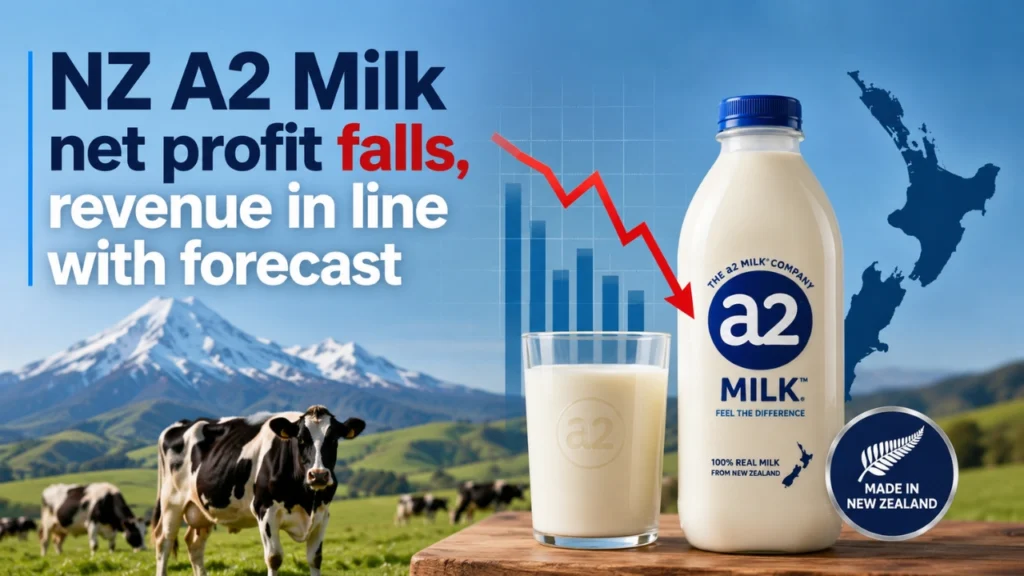
New Zealand dairy company a2 Milk has closed its 2026 financial year with a mixed scorecard. Revenue climbed to record levels, landing in line with the company’s own guidance, but reported net profit took a sharp hit after supply chain disruption choked off product availability in its most important market during the final quarter.
For a business that built its reputation on premium infant formula sales into China, the result is a reminder of how quickly a single quarter of stock shortages can ripple through a full year’s earnings, even when demand for the brand itself hasn’t gone away.
What Happened to a2 Milk’s Profit
For the year ended 30 June 2026, a2 Milk’s net profit attributable to shareholders dropped to NZ$113.6 million, a fall of roughly 44% compared with NZ$202.9 million the year before. The result also came in below analyst expectations, which had pointed to a figure closer to NZ$121 million.
On an underlying basis — a measure that strips out one-off costs tied to last year’s acquisition of the a2 Pōkeno manufacturing facility — profit actually rose. Underlying net profit reached NZ$235.8 million, up 7% on the prior year, suggesting the core business held up better than the headline number implies.
Group revenue rose 12.4% to NZ$1.975 billion, matching the company’s own guidance despite the turbulence in the fourth quarter. Reported EBITDA slipped modestly, down around 2.5%, while underlying EBITDA improved by 5.4%, again pointing to a business whose base operations remained reasonably healthy through the disruption.
Why the Numbers Diverged: The China-Label Supply Problem
The gap between a solid revenue year and a weak headline profit comes down to one issue: a shortage of a2 Milk’s China-label infant milk formula (IMF) in the final quarter of the financial year.
Strong demand through the third quarter, combined with a production backlog and higher freight costs, left the company short of stock heading into the June quarter. That shortage hit hard. Revenue from China-label IMF sales fell 14% for the year to NZ$544.3 million, as existing customers who couldn’t find product on shelves switched to competing brands.
a2 Milk has said stock levels have since recovered significantly, and the company is now focused on winning back lapsed customers while pushing to recruit new ones. Whether that effort succeeds will shape a large part of next year’s result.
It wasn’t all bad news on the China front, though. Revenue from the broader China & Other Asia segment, which includes English-label infant formula sold into the market, actually rose 11.2% to NZ$1.45 billion, helped by continued momentum in English-label products. That performance suggests the disruption was concentrated in one product line rather than a broader loss of demand for the a2 brand.
Dividend and Shareholder Returns
Despite the profit fall, a2 Milk’s board declared a final dividend of 9.5 New Zealand cents per share, down from 11.5 cents a year earlier. The reduction reflects the lower reported profit for the year, though the payout still signals confidence in the underlying business.
Looking Ahead to FY2027
a2 Milk has flagged a more cautious growth outlook for the year ahead. The company expects revenue growth in the mid-single-digit percentage range for FY2027, a marked slowdown from the 12.4% growth achieved in FY2026. Management has indicated that first-half revenue is likely to be broadly flat compared with the same period last year, with growth more heavily weighted toward the second half.
Infant formula sales are expected to be broadly similar to FY2026 levels overall, with China-label sales expected to recover gradually through the year and English-label momentum improving in the first half, aided by increased marketing spend. EBITDA margin guidance for FY2027 sits around 15%, though the company has cautioned this will be materially lower than the margin achieved in the first half of FY2026.
Analysts have offered a mixed reaction. Some have welcomed a2 Milk’s reduced reliance on China-label IMF as a sign of a more diversified business, while others have described the pace of recovery from the supply disruption as slower than hoped, especially given how the stock has historically traded on growth expectations.
A2 Milk FY2026 Results at a Glance
| Metric | FY2026 | FY2025 | Change |
|---|---|---|---|
| Net profit (reported) | NZ$113.6 million | NZ$202.9 million | -44% |
| Net profit (underlying) | NZ$235.8 million | ~NZ$220.4 million | +7% |
| Group revenue | NZ$1.975 billion | ~NZ$1.76 billion | +12.4% |
| EBITDA (reported) | Down | — | -2.5% |
| EBITDA (underlying) | Up | — | +5.4% |
| China-label IMF revenue | NZ$544.3 million | ~NZ$633 million | -14% |
| China & Other Asia revenue | NZ$1.45 billion | ~NZ$1.30 billion | +11.2% |
| Final dividend per share | 9.5 NZ cents | 11.5 NZ cents | -17.4% |
| FY2027 revenue growth guidance | Mid-single-digit % | — | Slowdown vs FY2026 |
| FY2027 EBITDA margin guidance | ~15% | — | Lower than 1H FY2026 |
Figures are based on a2 Milk’s FY2026 annual results announcement and subsequent market reporting. Some FY2025 comparative figures are approximate, derived from percentage changes disclosed by the company.
FAQs
Q1: Why did a2 Milk’s net profit fall so sharply in FY2026?
The drop was driven mainly by a shortage of China-label infant formula in the fourth quarter. Strong prior demand, a production backlog, and rising freight costs left shelves under-stocked, pushing loyal customers toward rival brands and denting reported earnings even as revenue kept growing.
Q2: Is a2 Milk’s underlying business still healthy?
Yes, on the numbers management prefers to highlight. Underlying net profit rose 7% and underlying EBITDA rose 5.4%, indicating that once one-off costs are excluded, the core operations performed reasonably well despite the fourth-quarter disruption.
Q3: Why did revenue grow while profit fell?
Revenue growth was supported by strong English-label infant formula sales and broader momentum across the China & Other Asia region, which offset weaker China-label volumes. Profit, however, was hit by the cost and margin impact of the supply shortage and lower reported EBITDA.
Q4: What does a2 Milk expect for FY2027?
The company is guiding for mid-single-digit revenue growth, a slower pace than FY2026’s 12.4%, with growth weighted toward the second half. It expects China-label sales to recover gradually through the year and EBITDA margin to sit around 15%.