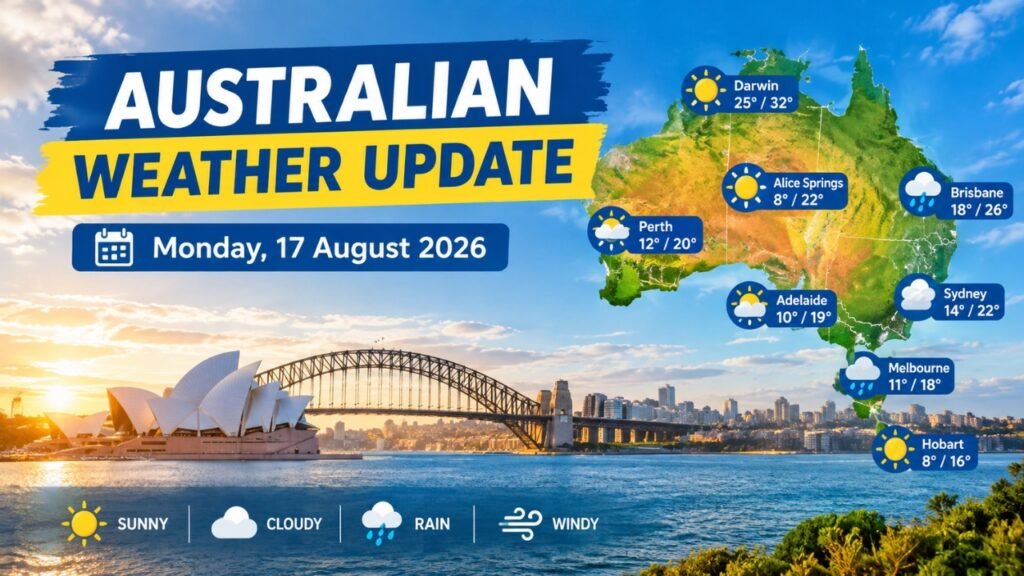
Every weekday morning, thousands of Nepali-speaking Australians start their day the same way — by tuning in to SBS Nepali’s short weather podcast before they head out for work, school, or the school run. The episode published on 16 August 2026, covering Monday, 17 August 2026, is no different. In under two minutes, host Niraj Khanal and the SBS Nepali team run through conditions across fifteen major Australian locations: Broome, Perth, Adelaide, Melbourne, Hobart, Albury-Wodonga, Canberra, Wollongong, Sydney, Newcastle, Brisbane, Townsville, Cairns, Darwin, and Alice Springs.
For members of the Nepali community — many of whom are still building confidence with English-language weather bulletins, or who simply prefer news in their mother tongue — this daily update has become a small but genuinely useful ritual. It removes the guesswork of deciding what to wear, whether to carry an umbrella, or whether outdoor plans need rescheduling, all delivered in a language that feels like home.
Why a Nepali-Language Weather Bulletin Matters
Australia is a big, climatically diverse country. A “typical” Monday in mid-August can mean crisp single-digit mornings in Canberra and Hobart, mild coastal sunshine in Sydney and Brisbane, and warm, dry, almost pre-summer conditions in Darwin and Alice Springs — all on the same date. For new migrants and international students, this variability can be confusing, especially if they’ve recently arrived from Nepal’s more predictable Himalayan or Terai climate patterns.
SBS Nepali’s format solves this neatly. Rather than a single national forecast, the podcast breaks conditions down city by city, so a listener in Wollongong doesn’t have to sit through irrelevant details about Cairns, and someone in Alice Springs gets information specific to the desert interior rather than generic capital-city coverage.
The Bigger Picture: Late-Winter Australia Heading Toward Spring
Mid-to-late August sits right at the tail end of the Southern Hemisphere winter, and 2026 has followed the pattern meteorologists have been tracking for weeks: a mild, almost spring-like airmass pushing across the southeastern states. Weatherzone’s outlook for the week of 17 August notes that cities such as Melbourne and Adelaide are expected to push close to 20°C, Hobart is forecast to approach 19°C by midweek (well above its August average of roughly 13°C), and Canberra is tipped to reach the high teens later in the week, comfortably above its seasonal norm of around 14°C.
The Bureau of Meteorology’s Canberra Central forecast issued on the morning of 17 August described cloudy conditions with a chance of morning fog and a medium chance of showers, moderate winds shifting from southeasterly to easterly through the day, and a moderate UV index of 4 — a timely reminder that even in winter, Australian sun protection advice still applies around the middle of the day.
Meanwhile, the country’s north — Darwin, Alice Springs, Townsville, and Cairns — continues to sit in its dry season, meaning warm days, low humidity variation, and little to no rainfall, a sharp contrast to the showery, cool conditions further south.
Snapshot Table: Typical Mid-August Conditions Across the Cities Covered
The table below summarises the general seasonal pattern for the cities named in the 17 August 2026 SBS Nepali episode. Because exact daily figures shift with each Bureau of Meteorology update, listeners planning their day should treat this as a general guide and check the podcast itself, or bom.gov.au, for the precise numbers on the morning in question.
| City | Region | Typical Mid-August Pattern | Practical Note |
|---|---|---|---|
| Broome | WA (north) | Warm, dry, sunny | Dry season; light layers, sun protection |
| Perth | WA (south) | Cool mornings, mild days | Jacket for early starts |
| Adelaide | SA | Cool, trending milder | Approaching high teens by midweek |
| Melbourne | VIC | Cool with spring-like warm-up | Layer up; changeable through the day |
| Hobart | TAS | Cold mornings, unusually mild afternoons | Above-average warmth forecast this week |
| Canberra | ACT | Cold, foggy mornings, showers possible | UV protection advised near midday |
| Albury-Wodonga | NSW/VIC border | Cold mornings, inland variability | Fog risk at dawn |
| Wollongong | NSW (coast) | Mild, coastal | Umbrella handy for onshore showers |
| Sydney | NSW | Mild days, cool nights | Comfortable for outdoor activity |
| Newcastle | NSW | Mild, coastal | Similar to Sydney, slightly cooler |
| Brisbane | QLD | Warm, pleasant | Ideal outdoor conditions |
| Townsville | QLD (north) | Warm, dry season | Minimal rain risk |
| Cairns | QLD (far north) | Warm, humid-dry | Light clothing suitable |
| Darwin | NT | Hot, dry season | Hydration and sun care recommended |
| Alice Springs | NT (interior) | Warm days, cold desert nights | Big day–night temperature swing |
Table compiled from Bureau of Meteorology forecasts and Weatherzone’s seasonal outlook for the week of 17 August 2026. Figures are indicative of the pattern discussed in the SBS Nepali bulletin rather than exact hourly readings.
How to Listen
The episode runs for just under two minutes and is available through SBS Nepali’s regular channels — the SBS Audio app (iOS and Android), Apple Podcasts, Spotify, and YouTube, as well as a direct downloadable file on the SBS website. It sits within SBS Nepali’s daily programming lineup, alongside news headlines and community-interest segments, making it easy to catch as part of a broader daily listening habit rather than a standalone tune-in.
For many listeners, the appeal isn’t just the forecast itself but the format: familiar voices, a relaxed pace, and information presented without the jargon that can make English-language bulletins harder to follow at speed.
Why This Kind of Local-Language Content Keeps Growing
Weather might seem like a small thing, but for migrant communities it’s one of the most practical, daily-relevant pieces of information there is. SBS’s continued investment in short, city-specific, in-language weather updates reflects a broader trend across multicultural broadcasting: meeting audiences where they are, in the language they think in, with content short enough to fit into a busy morning routine.
As Australia’s Nepali-speaking population continues to grow, particularly around Sydney, Melbourne, and Canberra, these daily two-minute updates are quietly becoming part of the everyday information diet — right alongside news headlines and community stories.
Frequently Asked Questions
1. Which cities does the SBS Nepali weather podcast cover?
The 17 August 2026 episode covers Broome, Perth, Adelaide, Melbourne, Hobart, Albury-Wodonga, Canberra, Wollongong, Sydney, Newcastle, Brisbane, Townsville, Cairns, Darwin, and Alice Springs.
2. What language is the podcast in, and how long is it?
It’s presented entirely in Nepali and runs for approximately two minutes, making it a quick daily listen.
3. Where can I listen to the SBS Nepali weather update?
Via the SBS Audio app, Apple Podcasts, Spotify, YouTube, or as a direct download from the SBS website, usually published the evening before the date it covers.
4. Is mid-August generally warm or cold in Australia?
It depends on the region. Southern cities like Hobart, Canberra, and Melbourne are still in cool, late-winter conditions with occasional mild spells, while northern cities like Darwin, Cairns, and Broome remain in their warm, dry season.